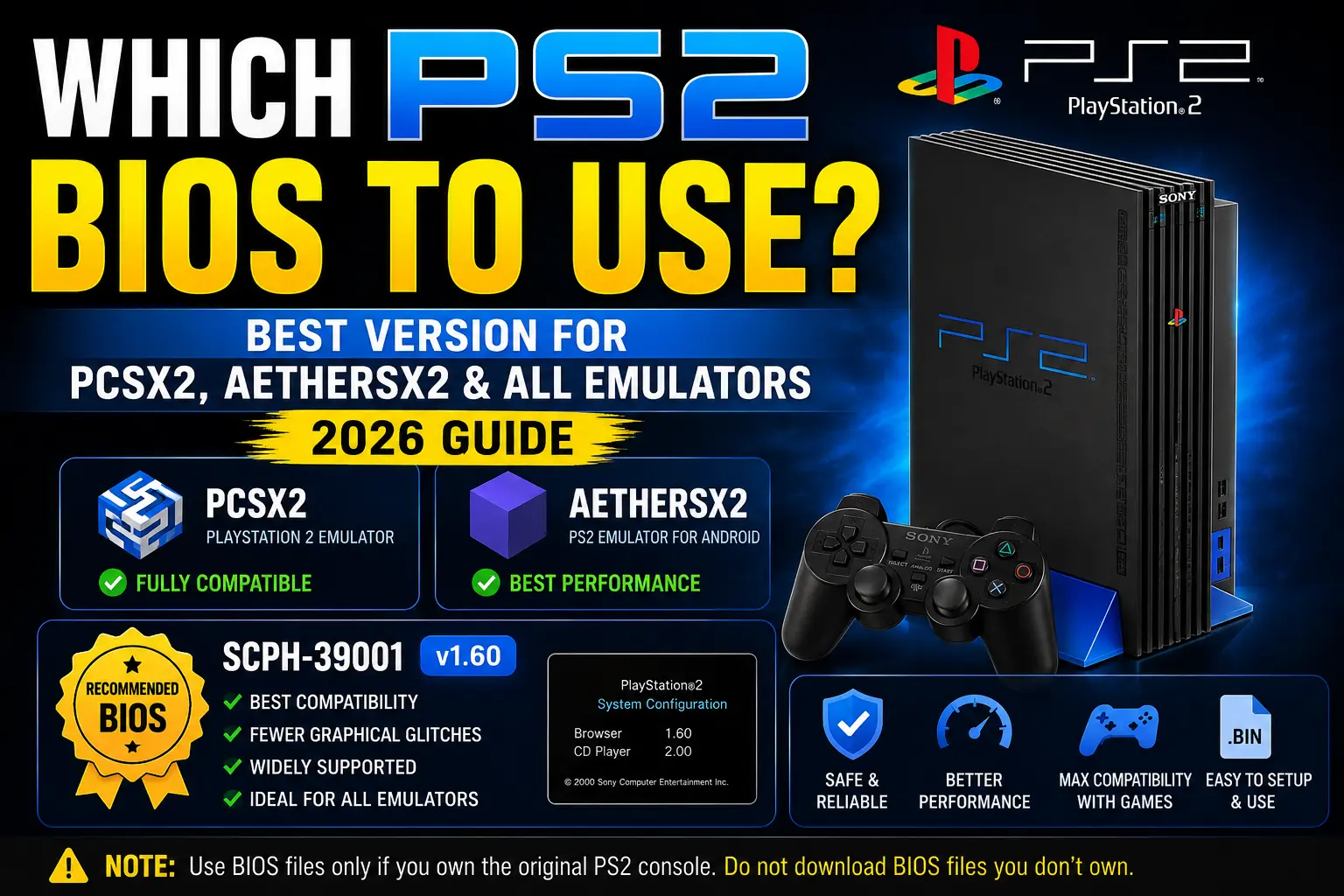
Which PS2 BIOS to Use? Best Version for PCSX2, AetherSX2 and All Emulators (2026 Guide)
Downloaded a PS2 BIOS file but still confused about which version to select? You’re not alone. Many gamers download multiple BIOS files, load one randomly, and then face black screens, crashes, slow performance, or game compatibility issues.
The truth is simple: the BIOS version you choose can directly affect game compatibility, emulator stability, save data reliability, and overall performance. Whether you’re using PCSX2, AetherSX2, NetherSX2, or RetroArch, selecting the right BIOS helps you get smoother gameplay and fewer problems.
In this guide, you’ll learn exactly which PS2 BIOS version to use, which region works best, and how to choose the right BIOS for your emulator and games.
What Is the PS2 BIOS and Why Does the Version Matter?
A PS2 BIOS (Basic Input Output System) is the original system software found inside every PlayStation 2 console.
When you use an emulator, the BIOS acts as the bridge between the emulator and your game. Without it, most PS2 emulators cannot properly recreate original PS2 hardware behavior.
A correct BIOS helps with:
- Better game compatibility
- Faster game loading
- Fewer crashes and bugs
- More accurate emulation
- Stable save files and memory card support
If you want to play PS1 games on Android or pc Then You need PS1 Bios For Your Emulator.
Complete PS2 BIOS Version History
Different PS2 consoles shipped with different BIOS versions. Each version offers slightly different compatibility and performance.
BIOS v1.60 (SCPH-39001)
This is one of the earliest stable BIOS versions available.
Best For
- Older PS2 games
- Low-end Android devices
- Older PCs
Pros
- Lightweight
- Fast boot times
- Great for early PS2 titles
Cons
- Some newer games may experience graphical issues
- Lower compatibility than newer BIOS versions
BIOS v1.70 (SCPH-50001)
Version 1.70 introduced several stability improvements over v1.60.
Best For
- Mid-generation PS2 games
- Users wanting balanced performance
Pros
- Better game stability
- Improved loading times
- Fewer crashes
Cons
- Not as refined as v1.90 or v2.00
BIOS v1.90 (SCPH-70012)
This is the most recommended BIOS version for most users.
Best For
- PCSX2
- AetherSX2
- NetherSX2
- RetroArch
Pros
- Excellent compatibility
- Stable performance
- Works with most PS2 games
- Balanced resource usage
Cons
- Slightly larger than older BIOS versions
BIOS v2.00 / v2.20 (SCPH-90001)
These versions came from later PS2 Slim models.
Best For
- High-end PCs
- Modern Android devices
- Maximum compatibility
Pros
- Best overall stability
- Better save handling
- Improved game support
- Refined firmware fixes
Cons
- Slightly heavier on low-end hardware
PS2 BIOS Regions Explained
Before discussing which version number to use, the region is the first decision you must make correctly. Using the wrong region for your game library causes more problems than any version mismatch.
Sony manufactured the PS2 in four distinct regional formats. Each region has its own BIOS with its own video standard, language configuration, and region lockout rules.
NTSC-U (USA)
Recommended Models
- SCPH-39001
- SCPH-70012
- SCPH-90001
Best For
- North American games
- Most emulator users
The USA BIOS is generally considered the safest choice because it offers excellent compatibility across most emulators.
PAL (Europe)
Recommended Models
- SCPH-50004
- SCPH-90004
Best For
- European games
- Multi-language support
PAL BIOS versions support several European languages and work best with PAL game releases.
NTSC-J (Japan)
Recommended Models
- SCPH-30000
- SCPH-50000
- SCPH-70000
Best For
- Japanese-exclusive games
- Import titles
If you’re playing Japanese RPGs or Japan-only releases, NTSC-J BIOS usually provides the best compatibility.
Every BIOS Version Explained — What Each One Actually Does
BIOS v1.60 — SCPH-39001 (USA Launch Model)
This is the BIOS that shipped with the first North American PlayStation 2 consoles. It established the baseline for all subsequent versions and handles the early PS2 library reliably. v1.60 is lightweight, uses fewer system resources, and boots quickly on lower-specification hardware.
Strengths: Best compatibility with early PS2 launch titles from 2000 to 2002. Lowest resource usage. Works well on older PCs and budget Android devices.
Weaknesses: Missing DVD player improvements added in later versions. Some later PS2 titles from 2004 onward show minor graphical glitches. Does not include the save system fixes added in v2.00.
Best for: Playing PS2 launch titles, users on lower-specification hardware, anyone who needs the lightest possible BIOS.
Specific games that run best on v1.60: Tekken 4, SSX Tricky, Gran Turismo 3, Twisted Metal Black, TimeSplitters
BIOS v1.70 — SCPH-50001 (USA Mid-Generation)
Sony’s first significant firmware upgrade for the North American market. v1.70 addressed DVD compatibility issues that affected a portion of the library in v1.60 and improved overall system stability. It became the most widely recommended version for general use in the PCSX2 community for many years.
Strengths: Improved DVD player code. Better stability than v1.60 across a wider game range. Reliable with both early and mid-generation titles. Good balance between resource usage and compatibility.
Weaknesses: Predates the save system improvements in v2.00. Some late PS2 titles (2005 to 2008) still show compatibility gaps.
Best for: Balanced general use across the mid-generation PS2 library. Users who want broader compatibility than v1.60 without the hardware demands of newer versions.
Specific games that run best on v1.70: Burnout 3, Silent Hill 2 and 3, Jak II, Ratchet and Clank 2 and 3, and Sly Cooper
BIOS v1.90 — SCPH-70012 (USA Slim Launch)
This version launched alongside the PlayStation 2 Slim in 2004 and represents Sony’s most substantial BIOS update. It added improved DVD player support, better region handling, refined memory card behavior, and significant performance improvements across the board. v1.90 is the current standard recommendation from the PCSX2 development team for most users.
Strengths: Best overall compatibility across the entire PS2 library. Handles both early launch titles and late-generation games reliably. Improved DVD player code reduces compatibility gaps. Works well on all hardware tiers.
Weaknesses: Slightly higher resource usage than v1.60 and v1.70. A very small number of early launch titles prefer the original v1.60 firmware behavior.
Best for: General-purpose use across the full PS2 library. The single best version for users who want one BIOS that covers everything.
Specific games that run best on v1.90: God of War I and II, GTA San Andreas, Resident Evil 4, Shadow of the Colossus, Metal Gear Solid 3, Kingdom Hearts II, Final Fantasy XII
BIOS v2.00 — SCPH-77001 (USA Late Slim)
Sony’s penultimate BIOS update added significant save system fixes that resolved memory card write errors affecting a portion of the library in earlier versions. It also improved DVD region handling and refined system behavior for late-generation titles.
Strengths: Fixes save system bugs present in all earlier versions. Best compatibility with PS2 titles released between 2006 and 2009. Improved memory card write reliability.
Weaknesses: Higher resource usage. A small number of users report specific early titles behaving differently compared to v1.70 or v1.60.
Best for: Playing late-generation PS2 titles. Users who experience save-related issues on earlier BIOS versions. High-end PC and flagship Android users.
Specific games that run best on v2.00: God of War II, Persona 3 and 4, Dragon Ball Z Budokai Tenkaichi 3, Naruto Shippuden Ultimate Ninja 5, Guitar Hero series
BIOS v2.20 — SCPH-90001 (Final USA Slim Model)
The last BIOS version Sony ever released for the PlayStation 2. It represents the most refined and stable version of the PS2 firmware and offers the highest compatibility across the complete library. v2.20 is the version found in late SCPH-90000 series consoles manufactured from 2008 onward.
Strengths: Maximum stability. Best memory card compatibility. Most refined save system. Highest compatibility with late PS2 titles. Recommended for users who want the definitive firmware version regardless of hardware demands.
Weaknesses: Highest resource usage of any BIOS version. It may be slightly slower on very low-specification hardware. A tiny number of original launch titles have subtle behavior differences compared to v1.60.
Best for: High-end PC setups, flagship Android devices, users who want the most stable and complete emulation experience available.
Best PS2 BIOS for PCSX2 Emulator
If you’re using PCSX2 on Windows, macOS, or Linux, the best choice for most players is:
Recommended BIOS
SCPH-70012 (NTSC-U) v1.90
Why?
- Excellent compatibility
- Stable save states
- Smooth performance
- Works with nearly all popular PS2 games
For users who want maximum stability, SCPH-90001 v2.20 is also a great option.
Best PS2 BIOS for AetherSX2 and NetherSX2 Emulator
Android users generally get the best results with:
Recommended BIOS
SCPH-70012 (NTSC-U) v1.90
This version provides:
- Better game compatibility
- Faster loading
- Stable frame rates
- Reliable memory card support
Many Android users also report excellent results using v2.00 and v2.20 on newer Snapdragon devices.
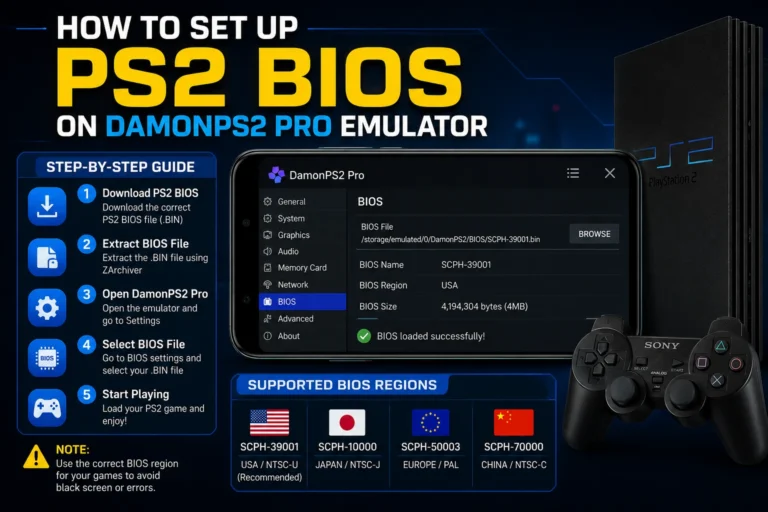
Best PS2 BIOS for DamonPS2 (Android)
DamonPS2 accepts all standard .BIN BIOS files. It performs most consistently with SCPH-70012 (v1.90) for general use and SCPH-39001 (v1.60) on older or lower-specification Android devices. The Pro version of DamonPS2 unlocks widescreen support and additional save slots.
Best PS2 BIOS for EmuDeck and Steam Deck
EmuDeck is a popular emulation setup tool for the Steam Deck running SteamOS (Linux). It automatically configures PCSX2 as the PS2 emulator and creates the correct folder structure. You simply place your BIOS files in the designated location.
EmuDeck BIOS folder path: Emulation/bios/
Place your BIOS .BIN files directly into this folder. EmuDeck’s PCSX2 configuration picks them up automatically. For Steam Deck specifically, SCPH-70012 (v1.90) is the recommended version — it runs at full speed on the Steam Deck’s AMD APU on most PS2 titles at 2x internal resolution.
Per-Game BIOS Recommendations — 25 Most Popular PS2 Titles
This section exists nowhere else. Most guides give you one recommendation and move on. Different games genuinely perform better on different BIOS versions.
| Game | Recommended BIOS | Reason |
| God of War II | SCPH-70012 v1.90 | Best stability with v1.90 firmware |
| GTA San Andreas | SCPH-70012 v1.90 | Broad compatibility, stable saves |
| Resident Evil 4 | Any NTSC-U version | Runs on all USA BIOS versions |
| Final Fantasy X | SCPH-70012 v1.90 + Full Boot | Depends on the game region |
| Shadow of the Colossus | SCPH-70012 v1.90 + Full Boot | Full Boot required for correct launch |
| Metal Gear Solid 3 | SCPH-70012 v1.90 | Best stability on v1.90 |
| Kingdom Hearts II | SCPH-70012 v1.90 | Stable across v1.90 and v2.00 |
| Tekken 5 | SCPH-39001 v1.60 or v1.90 | Works on both, slight edge to v1.60 |
| GTA Vice City | Any NTSC-U version | Stable on all USA BIOS |
| Persona 3 | SCPH-77001 v2.00 | Save system improvements needed |
| Persona 4 | SCPH-77001 v2.00 | Save system improvements needed |
| Final Fantasy XII | SCPH-70012 v1.90 | Best on v1.90 Slim firmware |
| Dragon Ball Z Budokai Tenkaichi 3 | SCPH-77001 v2.00 | Late-generation title benefits from v2.00 |
| Devil May Cry 3 | SCPH-50001 v1.70 or v1.90 | Both work reliably |
| Ico | SCPH-10000 NTSC-J or SCPH-39001 NTSC-U | Early title works best on the launch BIOS |
| Katamari Damacy | SCPH-50000 NTSC-J | Japanese original requires NTSC-J |
| Silent Hill 2 | SCPH-50001 v1.70 | Mid-generation BIOS most stable |
| Burnout 3 | SCPH-50001 v1.70 | Reliable on v1.70 |
| Gran Turismo 4 | SCPH-70012 v1.90 | Needs Slim-era firmware for best performance |
| Ratchet and Clank 3 | SCPH-50001 v1.70 or v1.90 | Both work well |
| Jak II | SCPH-50001 v1.70 | Mid-generation firmware match |
| Twisted Metal Black | SCPH-39001 v1.60 | Launch-era title runs best on v1.60 |
| Guitar Hero II | SCPH-77001 v2.00 | Late-generation title benefits from v2.00 |
| Pro Evolution Soccer 6 | SCPH-75004 PAL v1.90 | PAL-region title — use PAL BIOS |
| Sly Cooper and the Thievius Raccoonus | SCPH-39001 v1.60 | Early title works best on launch BIOS |
NTSC vs PAL — Understanding the Speed Difference
This is one of the most misunderstood topics in PS2 emulation. Here is the complete explanation.
NTSC games run at 60 frames per second by design. PAL games run at 50 frames per second. When you run a PAL game through an NTSC BIOS, the emulator attempts to run 50Hz content on a 60Hz system timing. This creates a persistent audio sync problem and can make the game feel slightly off in motion and sound.
The correct solution is always to use the PAL BIOS for PAL games and the NTSC BIOS for NTSC games. PCSX2 has a built-in workaround called EE Cycle Stretching that can compensate for frame rate mismatches in certain titles, but matching the BIOS to the game region is the proper fix that eliminates the issue entirely, rather than compensating for it.
Frequently Asked Questions
Which PS2 BIOS version is best overall?
For most users, SCPH-70012 (NTSC-U, v1.90) is the single best all-around choice. It covers the full PS2 library reliably, performs well on all hardware tiers, and is the version recommended by the PCSX2 development team.
Should I use a newer or older BIOS version?
Newer versions (v1.90, v2.00, v2.20) are better for most users because they cover more of the library and include important bug fixes. Older versions (v1.60, v1.70) are preferable only for early launch titles or on very low-specification hardware where the newer BIOS overhead causes performance issues.
Can I use a USA BIOS to play Japanese or European games?
Some games work with a mismatched BIOS due to loose region checking, but many will not boot at all, and those that do run may have speed or audio sync issues. Always use the BIOS that matches your game’s region for correct behavior.
Can I have multiple BIOS files in PCSX2 at the same time?
Yes. Place all .BIN files in the same BIOS folder. PCSX2 lists every detected version and lets you switch between them in seconds. This is strongly recommended for anyone who plays games from multiple regions.
Does the BIOS version affect game graphics quality?
No. Game visual quality in PCSX2 is determined by the internal resolution scaling, texture filtering, and renderer settings — not the BIOS version. The BIOS affects compatibility, stability, and system behavior rather than visual output.
Why does PCSX2 show a green checkmark on some BIOS files?
The green checkmark means PCSX2 has matched your file against its internal database of verified, unmodified PS2 BIOS dumps. Files without a checkmark may still work, but have not been verified. Red icons indicate corrupt or invalid files.
What is the difference between the BIOS versions for PCSX2 and AetherSX2?
There is no difference. Both emulators use the same standard PS2 BIOS .BIN files. The same SCPH-70012 file that works in PCSX2 on Windows works identically in AetherSX2 on Android.
Is a newer BIOS better for older games?
Not necessarily. Some launch titles from 2000 to 2002 were programmed specifically for the v1.60 firmware behavior. Running them on v2.20 occasionally produces subtle differences. This is rare, but it is why serious emulation users keep multiple BIOS versions available.
Final Recommendation
For most users, SCPH-70012 (NTSC-U) v1.90 is the best PS2 BIOS because it offers the perfect balance of compatibility, stability, and performance across PCSX2, AetherSX2, NetherSX2, and other PS2 emulators. If you’re using newer hardware, SCPH-90001 v2.20 is also a great option. For the best gaming experience, always choose a BIOS that matches your game’s region whenever possible. If you’re unsure, SCPH-70012 v1.90 is the safest and most recommended choice in 2026.